Rodin 2.5 vs Tripo P1 vs Hunyuan 3D: Which AI 3D Model Should You Use?
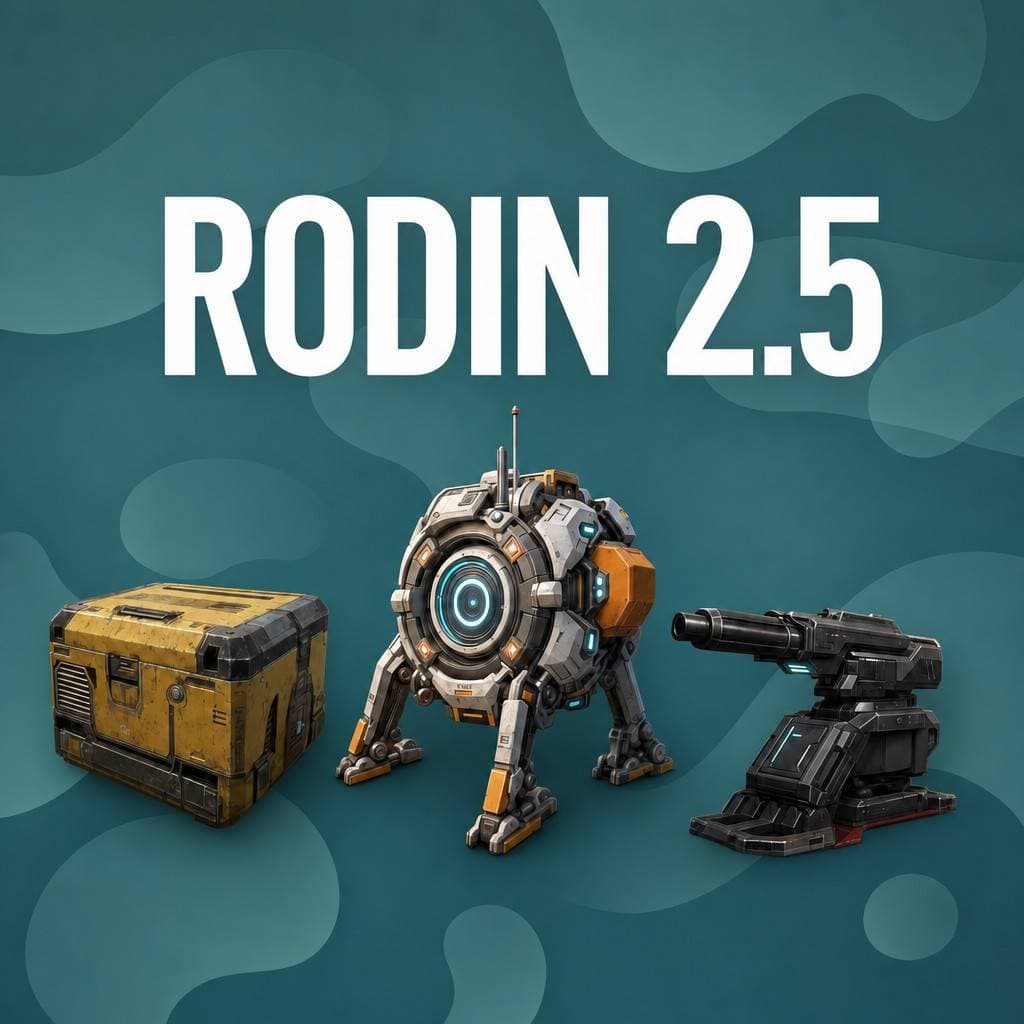
Three strong models, three different philosophies. Rodin Gen-2.5, Tripo P1, and Hunyuan 3D are all available on 3D AI Studio, and each one is optimized for a different workflow. Here's an honest comparison with real numbers so you can pick the right tool for your project.
Quick Comparison
| Feature | Rodin Gen-2.5 | Tripo P1 | Hunyuan 3D |
|---|---|---|---|
| Built by | Hyper3D (Deemos) | Tripo | Tencent |
| Input types | Text, image, multi-image | Text, image, multi-view | Text, image, multi-view |
| Generation speed | 30s to 7 min (5 tiers) | 60-90 seconds | 3-4 minutes |
| Cost on 3D AI Studio | 20-35 credits | 60 credits | 40 credits |
| Max polygons | Up to 2M faces | Up to 20K faces | Up to 1.5M faces |
| PBR textures | Included | Included | Optional (extra credits) |
| Texture control | HD enhancement, delighting, 5 quality levels | Standard/Detailed | PBR toggle |
| Creative mode | Yes (Medium/High tiers) | No | No |
| Symmetry control | Yes | No | No |
| Best for | Flexible speed/quality, production pipelines | Game-ready low-poly assets | Maximum quality ceiling |
| Commercial use | Yes | Yes | Yes |
Where Rodin Gen-2.5 Wins
Rodin Gen-2.5 is the most flexible model of the three. It gives you more knobs to turn than anything else on the platform.
Five quality tiers. Lowest, Low, Medium, High, and Ultra. No other model lets you choose your speed/quality tradeoff this precisely. Need a 30-second draft? Use Lowest. Need maximum detail? Use Ultra at 7 minutes. Every project has different requirements for different assets, and Rodin lets you match each one.
Cheapest per credit for quality output. Medium and High tiers cost 30 credits and produce polished results. That's half the cost of Tripo P1 (60 credits) and cheaper than Hunyuan 3D (40 credits) for comparable quality.
Creative geometry mode. Available on Medium and High tiers, this produces more polished, robust geometry. The model takes more creative liberties with the shape, which often means cleaner surfaces and better proportions.
Advanced texture controls. Five texture quality levels, HD enhancement for sharper details, and delighting to remove baked-in lighting from your source image. Neither of the other two models give you this much control over the texture pipeline.
Force symmetry. One toggle to ensure characters, vehicles, and mechanical objects come out symmetric. Small feature, huge time saver.
Micro detail. The Ultra tier adds an extra pass for ultra-fine surface detail. Pores, stitching, engravings, anything that needs sub-millimeter precision.
Multi-image support. Feed 2 to 5 views of your object for more accurate reconstruction. Works especially well for objects that look different from different angles.
Where Tripo P1 Wins
Tripo P1 does one thing extremely well: game-ready meshes.
Optimized topology. P1 outputs clean, efficient meshes with proper edge flow. The polygon budget tops out at 20K faces, which sounds like a limitation until you realize that's exactly what most game engines want. No retopology needed.
Consistently fast. Every generation takes 60-90 seconds. No tier complexity, no decisions to make. Upload your input, get your model in about a minute.
Best for real-time applications. If your asset needs to run at 60fps on a mobile device or in a VR headset, P1's low-poly output is already optimized for that use case. Other models give you millions of faces that you'll need to decimate anyway.
Game-engine-ready without post-processing. The output plugs directly into Unity, Unreal, or Godot without cleanup. Textures are properly UV-mapped, topology is clean, and poly counts are within budget.
Where Hunyuan 3D Wins
Hunyuan 3D pushes the quality ceiling higher than the other two when you need maximum fidelity.
Highest quality ceiling. With 8K PBR textures and up to 1.5M faces, Hunyuan 3D produces the most detailed output when you max out the settings. For hero assets, product visualization, or 3D printing, this matters.
Most reliable results. Hunyuan 3D is the most consistent of the three. It rarely produces broken geometry or obvious artifacts. You know what you're going to get.
Named multi-view input. You can tell it exactly which angle each image represents: front, left, right, back, top, bottom. No guesswork, the model knows exactly where each view is coming from.
Multiple generation modes. Normal, LowPoly, Geometry, and Sketch modes let you control the output style. Sketch mode is particularly handy for turning rough concept art into 3D models.
When to Use Each
Use Rodin Gen-2.5 when:
- You have a production pipeline that needs different quality levels for different assets
- You want to iterate fast with Lowest tier, then upscale winners to Ultra
- You need creative mode for more polished, stylized geometry
- Texture quality and control matter (delighting, HD enhancement)
- You're building characters or vehicles that need symmetry
- Budget efficiency matters and you want the most quality per credit
Use Tripo P1 when:
- You're building for games with strict polygon budgets
- Mobile games, AR, or VR where every triangle counts
- You need clean topology without retopology post-processing
- Consistent 60-90 second turnaround matters for your workflow
- Your pipeline expects low-poly game assets, not high-poly sculpts
Use Hunyuan 3D when:
- Maximum visual quality is the priority and cost is secondary
- You're 3D printing and need high polygon counts with clean surfaces
- You have named multi-view reference images (front, back, left, right)
- You want the most consistent, reliable output
- The asset is a hero piece that's worth the extra time and credits
Can You Use Multiple?
Yes, and honestly it's the smartest way to work. Here's what we'd suggest:
- Prototype with Rodin Gen-2.5 Lowest tier. At 20 credits and 30 seconds, it's the cheapest and fastest way to test whether your input produces a good 3D model.
- If the concept works, decide what you need the final asset for.
- For games: run it through Tripo P1 for game-ready topology.
- For maximum quality: generate with Rodin Gen-2.5 Ultra or Hunyuan 3D for the final production version.
This way you spend 20 credits to validate ideas and only invest 35-60 credits on the final version when you know it's worth it.
Try All Three for Free
All three models are available on 3D AI Studio. New accounts get free credits, so you can test each one on your own assets and see which fits your workflow.

Generate 3D models with AI
Easily generate custom 3d models in seconds. Try it now and see your creativity come to life effortlessly!