
5 Ways Businesses Are Using 3D Generation APIs in 2026
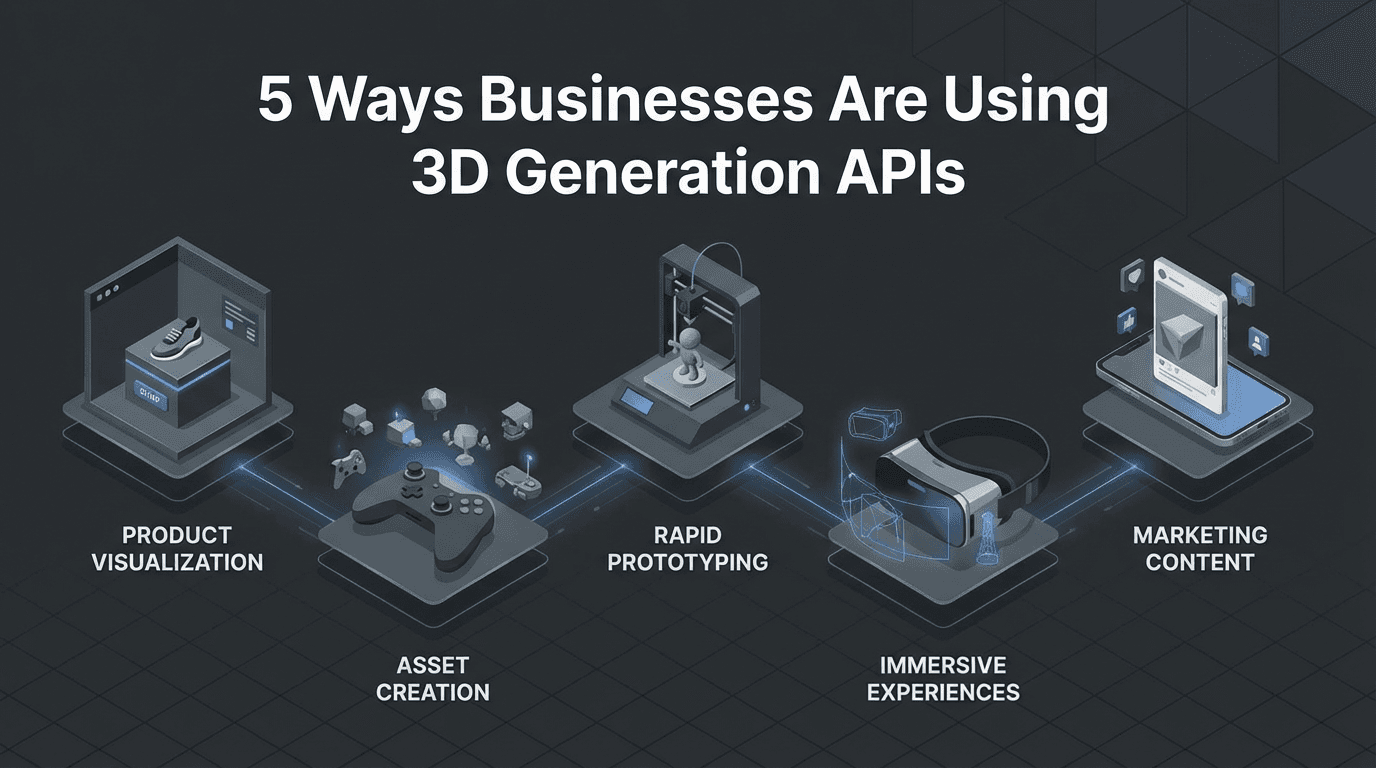
Two years ago, generating a 3D model from text or an image was a research demo. Today, businesses are running production pipelines that generate thousands of 3D assets per day through API calls. The technology has matured from "impressive demo" to "reliable business tool."
Here are five ways companies are actually using 3D generation APIs right now, with enough detail to understand whether each use case applies to your business.
1. E-Commerce Product Visualization
The problem is simple: online shoppers want to see products from every angle before buying. Traditional product photography requires physical samples, studio time, and a photographer for every SKU. For catalogs with thousands of products, that doesn't scale.
How 3D APIs solve this:
Companies are generating 3D models of their products from existing product photos. One photo goes in, a rotatable 3D model comes out. Customers can spin the product, zoom in, and inspect it from any angle directly on the product page.
The workflow typically looks like this: take your existing product catalog photos, send each through an image-to-3D API like TRELLIS.2 (which generates high-fidelity models with PBR materials from a single image), then embed the resulting GLB files in a 3D viewer on your product pages.
For larger catalogs, the mesh tools API handles post-processing automatically: optimize file size for web delivery, render thumbnail images from multiple angles, and convert between formats as needed.
The numbers that matter: A single product visualization costs a few cents in API credits and takes under 2 minutes to generate. Compare that to $50-200 for a professional 3D model or $30-100 for a product photography session. At scale, the savings are enormous.
Who's doing this: Furniture retailers, fashion brands, consumer electronics companies, and any e-commerce business with a large product catalog.
2. Game Development Asset Pipelines
Game studios need hundreds or thousands of 3D assets: characters, weapons, props, environment pieces, vehicles, buildings. A AAA game might have 10,000+ unique assets. Even indie games need hundreds. The traditional pipeline involves concept art, 3D modeling, UV mapping, texturing, and optimization, taking hours per asset.
How 3D APIs solve this:
Studios are using generation APIs for the early stages of their pipeline. Generate 10 concept variations of a "medieval tavern interior" in minutes, pick the best ones, then hand those to artists for refinement. The API handles the "first 80%" of the work, and skilled artists handle the final polish.
The Hunyuan 3D API is particularly useful here because it supports text-to-3D with configurable polygon counts (up to 1.5 million faces), multiple generation modes (Normal, LowPoly, Geometry), and optional PBR textures. For game-ready assets, you can generate a geometry-only model, then apply custom textures using the texturing API with your game's art style as reference.
Some studios are building fully automated background asset pipelines: describe an asset type ("wooden barrel", "stone wall section", "torch sconce"), generate variations, automatically optimize for the target polygon budget, and export to the engine.
Who's doing this: Indie studios using it for production assets, AAA studios using it for concepting and placeholder assets, and mobile game studios where asset budgets are tighter.
3. Custom 3D Printing and Figurine Businesses
This is one of the fastest-growing use cases. Customers upload a photo, and the business delivers a custom 3D-printed figurine of themselves, their pet, or any object. The entire pipeline from photo to print-ready file is automated.
How 3D APIs solve this:
The 3D printing API provides a complete pipeline: generate a 3D figurine from a photo (with 8 style presets for humans, animals, and objects), then repair the geometry, hollow the model to save material, scale to exact dimensions, and export as a print-ready STL.
What makes this viable as a business is the cost structure. Generating and preparing a single figurine costs roughly $1.50-2.50 in API credits and takes 5-10 minutes. Add $1-3 for printing material, $3-5 for shipping, and you're selling $30-80 figurines at 70%+ margins.
The miniature figurine flow is a single API endpoint that handles the entire generation process. Upload a photo, choose a style (miniature or realistic, full body or bust), and get back a textured 3D model ready for printing.
Businesses integrate this into Shopify or Etsy storefronts: customer uploads photo, selects style and size, order webhook triggers the API pipeline, print-ready file downloads automatically to the print queue.
Who's doing this: Custom figurine shops, tabletop gaming miniature businesses, corporate gift companies, wedding cake topper services, and pet portrait businesses.
4. AR/VR and Spatial Computing
Spatial computing platforms need 3D content at a scale that traditional 3D modeling can't deliver. Every AR experience, every VR environment, every spatial app needs 3D objects that look good and load fast.
How 3D APIs solve this:
For AR product try-on experiences, businesses generate 3D models of their products and deliver them as USDZ (iOS) or GLB (Android/web) files. The customer points their phone at a surface, and the product appears in their space at real-world scale.
The key technical requirement for AR is optimization: models need to be small (under 5MB), have efficient geometry, and load quickly on mobile. The mesh tools API handles this with Draco compression, texture resizing, and mesh simplification in a single API call. A model that starts at 30MB can be compressed to under 3MB while maintaining visual quality.
For VR environment building, teams generate background assets and props from text descriptions, then optimize them for real-time rendering. Generate a library of 100 office objects ("desk lamp", "coffee mug", "potted plant", "bookshelf") and you have enough variety to populate an entire virtual office environment.
Who's doing this: Furniture retailers with AR try-on, real estate companies with virtual staging, event companies building virtual venues, and training/simulation companies creating virtual environments.
5. Marketing and Content Creation
Marketing teams constantly need visual content: social media posts, ad creatives, product renders, presentation visuals, website hero images. 3D visuals stand out in feeds dominated by flat photography, but traditionally required a 3D artist for every piece of content.
How 3D APIs solve this:
The image generation API (with access to Google Gemini 3 Pro, Gemini 3.1 Flash, Gemini 2.5 Flash, and Seedream V5 Lite) generates marketing images from text descriptions. Combined with 3D generation, marketing teams can create product mockups, hero images, social content, and ad creatives without a studio or photographer.
A common workflow: generate a 3D model of a product concept, use the render endpoint to create professional turntable videos and product shots from multiple angles, then use the image generation API to create lifestyle scenes and marketing compositions featuring the product.
For product launches, you can generate all visual assets from a single product description before the physical product even exists. Product page renders, social media content, ad creatives, and press kit images, all generated from the same 3D model.
Who's doing this: DTC brands, marketing agencies, content studios, and any business that needs high-quality visual content at scale without per-asset production costs.
The Common Thread
All five use cases share the same pattern: take something that previously required specialized skills and significant per-unit cost, and turn it into an API call that costs pennies and takes minutes.
The businesses getting the most value are the ones integrating APIs into their existing workflows, not replacing their entire pipeline, but automating the parts that don't require human judgment. Generate the first draft with AI, let humans make the final decisions.
Getting Started
If any of these use cases match your business, the fastest path is:
- Get an API key (pay-as-you-go, no subscription)
- Try a few generations manually to understand the output quality
- Build a prototype integration with your existing workflow
- Scale up with custom rate limits when you're ready
The API documentation covers every endpoint, and the landing pages for Hunyuan 3D, TRELLIS.2, Image Generation, Texturing, Mesh Tools, and 3D Printing have detailed overviews of each capability.
For custom integrations or enterprise volume, reach out to jan@3daistudio.com.

Generate 3D models with AI
Easily generate custom 3d models in seconds. Try it now and see your creativity come to life effortlessly!